

In brief
- Cremation is not regulated by legislation in Israel, and state law does not prohibit it. The courts have ruled that the wish of a person who asked for their body to be cremated after death must be respected.
- In Israel cremation is carried out for a fee, by a private body, and is not covered by the National Insurance Institute's burial fees.
- The process itself takes about two hours. At the end the family receives a vessel with the ashes, and chooses what to do with it.
- The death grant from the National Insurance Institute does not depend on the type of burial, and is paid to those who meet the conditions even when cremation has been chosen.
- Cremation abroad is also possible, or bringing ashes from abroad to Israel. There, documents, authorities and the airline's rules come into play.
What cremation is
In cremation the body of the deceased is placed in a special furnace and burned at high heat. The process takes about two hours, and at the end the family receives a vessel with the ashes of the deceased.
This is not burial. It is not handled through a Chevra Kadisha (burial society) and does not take place in a cemetery. In Israel it is carried out by private bodies, paid for by the family.
How it works, step by step
- 1
The first moment
A doctor determines the death and issues a notification of death. With the notification of death, a death certificate is issued at the Ministry of the Interior.
- 2
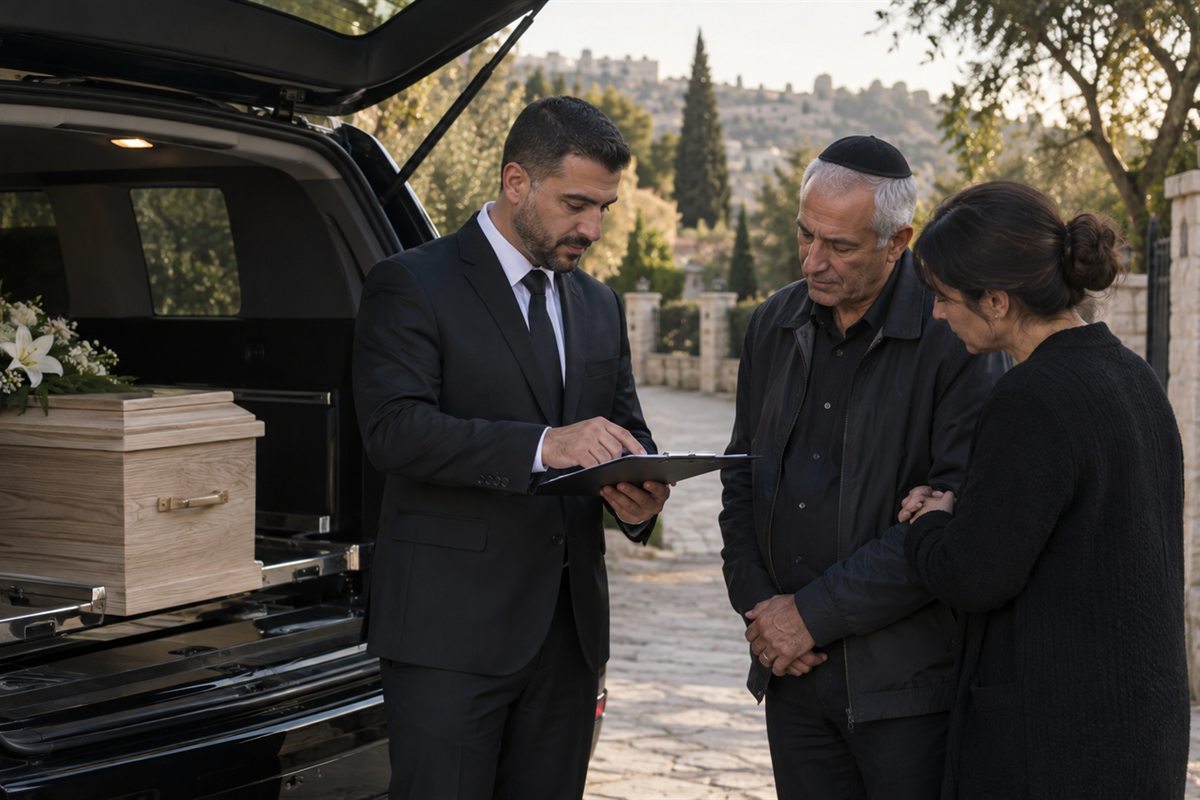
Removal and refrigerated storage
The deceased is removed from the place of death and held in refrigeration until the appointed time. The public funding for removal is part of the burial system, so when cremation is chosen you need to check in advance what is done within the public framework and what is paid for. We check this with you before we begin.
- 3
Coordination with the body that carries it out
The private body that carries out the cremation decides which documents and approvals are required and which dates are possible. We coordinate with them, collect the documents and update you at every stage.
- 4
Transport of the deceased
Transfer from the place where the deceased is to the place where the cremation takes place. If you have chosen abroad, the transport is to the airport, with everything the flight requires.
- 5
A farewell ceremony, if you wish
A farewell ceremony can be held before the cremation, and a separate gathering after it as well. There is no set form, and the family chooses what will be said and who will speak.
- 6
The cremation itself
The process takes about two hours.
- 7
Receiving the ashes
The family receives a vessel with the ashes, and from there the decision what to do with it is theirs.
What you are entitled to, and what we do
The public service
- The Ministry of the Interior: a death certificate, after the notification of death has been submitted.
- The National Insurance Institute: a death grant for those who meet the conditions, regardless of the type of burial. Burial fees, by contrast, are paid for a person who died in Israel and is buried in Israel, directly to the Chevra Kadisha (burial society) or to a body lawfully authorized to engage in burial, and so they do not apply to cremation.
- The national hotline *0120: answers and information on removal of the deceased and on burial, at any hour.
Avelut Israel, a private service
- Full coordination with the private body that carries out the cremation in Israel, including the documents it requires and the date.
- Removal and transport of the deceased, from anywhere in Israel.
- A farewell ceremony, if the family asks.
- Receiving the ashes and handing them to the family.
- Cremation abroad: flying the deceased out, the documents and the coordination with the authorities and the airline. And also bringing ashes from abroad to Israel.
- Human support the whole way, and afterwards too: shiva, memorial service, commemoration and claiming benefits.
Avelut Israel provides a private service of support, coordination and assistance for families after a death, alongside the public burial services and in keeping with the family's entitlements.
What the cost is made of
There is no single price for cremation in Israel: it is carried out by a private provider and is not covered by the National Insurance burial allowance. The total cost is usually made up of these parts:
- The payment to the private provider that carries out the cremation.
- Removal of the deceased and transport to the place of cremation, by distance.
- Refrigerated storage until the date, if there is a wait.
- The urn, if the family chooses a special one.
- A farewell ceremony, if the family asks.
- Our coordination, paperwork and support.
Choosing an urn
At the end of the process the ashes are handed to the family in a container. You can keep them in that container, or choose a special urn: wood, ceramic, metal, or a biodegradable urn made for burial in the ground or at sea.
The choice depends on what you plan to do with the ashes. Families who keep them at home usually choose a durable urn; for burial or scattering a simple container is enough. If the ashes will fly abroad, the airline has its own rules about the container, so check before buying.
What happens to the ashes
The family receives a vessel with the ashes and chooses what to do with it. Some families keep the vessel, some scatter the ashes in a place that was dear to the deceased, and some ask to inter it.
Any site, cemetery or local authority may have its own rules about interring or scattering ashes on its grounds. Before you decide it is worth checking with the specific body, and we help with that.
Cremation abroad, and bringing ashes to Israel
Some families choose to hold the cremation in another country, and there are cases in which a person died abroad and was cremated there, and the family wants to bring the ashes to Israel.
In both cases there are official documents, translations, authority approvals and airline rules. The international part is handled by our sister company, TLM, which specialises in transfers between countries. We set out the process and documents for repatriation on dedicated pages.
Cremation, civil burial, and the difference
Civil burial is burial in a civil cemetery with a non-religious ceremony. It is still burial, so it falls within what the National Insurance Institute funds, under the conditions it sets.
Cremation is not burial: it does not take place in a cemetery, it has no public funding, and Jewish religious law forbids it, so Chevra Kadisha (burial society) organizations do not deal with it. It is entirely a private choice of the deceased and of the family.
Common questions
How much does cremation cost in Israel?
There is no fixed price. Cremation is paid by the family, carried out by a private provider, and not covered by the National Insurance burial allowance. The cost is made up of the provider's fee, removal and transport, refrigerated storage if needed, the urn and our support. Before we start you receive a full breakdown and a price.
What is the difference between cremation and "sreifat gufa"?
There is none. They are two Hebrew names for the same process.
Is cremation legal in Israel?
The matter is not regulated by legislation, and state law does not prohibit it. The courts have ruled that the wish of a person who asked for their body to be cremated after death must be respected.
How long does cremation take?
The process itself takes about two hours. The full arrangement, including documents, transport and an available date with the body that carries it out, takes longer and varies from case to case.
Does the National Insurance Institute pay for cremation?
No. The National Insurance Institute pays burial fees for a person who died in Israel and is buried in Israel, directly to the Chevra Kadisha (burial society) or to a body lawfully authorized to engage in burial. Cremation is not covered by burial fees, and the cost is private.
Is the death grant still paid?
The death grant is a separate payment and does not depend on the type of burial. It is paid to the spouse of a person who, until their death, received one of the benefits listed in the law, and in the absence of a spouse, to a child who meets the conditions. As of 1.1.2026 the amount is NIS 10,514.
Who carries out cremation in Israel?
Private bodies, for a fee. We do not carry out the cremation: we coordinate with the body that does, handle everything around it and stay with the family.
Can a farewell ceremony be held?
Yes. A ceremony can be held before the cremation, and a separate gathering afterwards. There is no set form, and the family chooses the character, the place and who will speak.
What is done with the ashes?
The family chooses: to keep the vessel, to scatter the ashes or to inter them. Sites and authorities may have their own rules, so it is worth checking in advance.
Which urn should we choose?
It depends on what you will do with the ashes. To keep them at home, families usually choose a durable urn of wood, ceramic or metal. For burial or scattering, a simple container or a biodegradable urn is enough. If the ashes are flying abroad, check the airline's rules first.
Can cremation be done abroad, or ashes brought to Israel?
Yes, and we handle both directions: flying the deceased out for cremation in another country, and bringing ashes from abroad to Israel, including the documents and the coordination with the authorities and the airline.
Can a Jew choose cremation?
Jewish religious law forbids cremation, and Chevra Kadisha (burial society) organizations do not deal with it. State law does not prohibit it, and the courts have ruled that the wish of the deceased must be respected. The decision belongs to the deceased and to the family.
Sources
- National Insurance Institute: Cremation (procedure)
- National Insurance Institute: Burial fees
- National Insurance Institute: Who is entitled to burial fees
- National Insurance Institute: Death grant for the family of the deceased
- National Insurance Institute: Removal of the deceased from home
Last updated: 8.11.2026 The information on this page was checked against these sources on that date. Amounts, rates and procedures are updated, so it is worth checking the source as well.